

Hooked on Identity (Part 2): Abusing OAuth Trust Boundaries in Okta

Hooked on Identity (Part 2): Abusing OAuth Trust Boundaries in Okta
In part 2 of this blog series, Phantom Labs researcher Madhav Nakar explains how Okta Custom Authorization Servers can be abused to modify OAuth and OIDC tokens, and how defenders can prevent attackers from achieving privilege escalation and trusted claim manipulation as a result.
Overview: How Token Inline Hooks and Custom Authorization Servers Can Be Used to Manipulate Trusted Identity Claims
In OAuth 2.0 and OpenID Connect (OIDC) environments, applications and APIs rely on tokens issued by an Identity Provider (IdP) to make authentication and authorization decisions. Once validated, the contents of those tokens dictate a user's identity, privileges, scopes, and access rights within the target application or service.
In Okta, Custom Authorization Servers and Token Inline Hooks provide administrators with the ability to influence how OAuth and OIDC tokens are constructed before they are cryptographically signed and delivered to applications and APIs. While intended to support legitimate identity customization and authorization workflows, these capabilities operate directly within the token issuance trust boundary.
If an attacker gains control of these token issuance workflows, they can influence claims, scopes, group memberships, roles, and other authorization-relevant attributes before the token is signed. Since downstream applications validate the token’s signature rather than how its contents were constructed, these modified claims are treated as legitimate identity data. As a result, attackers can manipulate the identity and authorization context trusted by downstream applications without compromising those applications directly.
In environments where a centralized IdP issues tokens consumed across multiple applications, APIs, and cloud services, this represents a cross-platform security risk with potentially broad impact.
This blog explores:
What is OAuth?
What is OIDC?
How Tokens Become Trusted Authorization Decisions
Where Okta Constructs Tokens
Abuse Examples involving trusted OAuth and OIDC tokens
Attack Limitations
Detection opportunities for defenders
What is OAuth?
OAuth is an authorization framework that allows applications and APIs to grant access to protected resources using tokens issued by a trusted authorization server. In OAuth environments, applications and APIs do not independently verify a user's identity or determine what access should be granted. Instead, they trust tokens issued by an authorization server.
Before examining how Okta token issuance workflows can be abused, it is important to understand the trust relationship that makes those attacks possible.
In many enterprise environments, Okta serves as that authorization server. If a token is validly signed by a trusted issuer, the receiving application accepts the claims and scopes inside that token as authoritative.
At a high level, OAuth involves three important parties for this blog:
Client - The application requesting access
Authorization Server - The service that authenticates the requestor and issues tokens (Okta in this architecture)
Resource Server - The API or application that validates tokens and enforces access
Whether an application is acting on behalf of a user or authenticating directly as itself, the trust model remains the same. Okta constructs and signs a token, and the downstream application or API trusts what that token says.
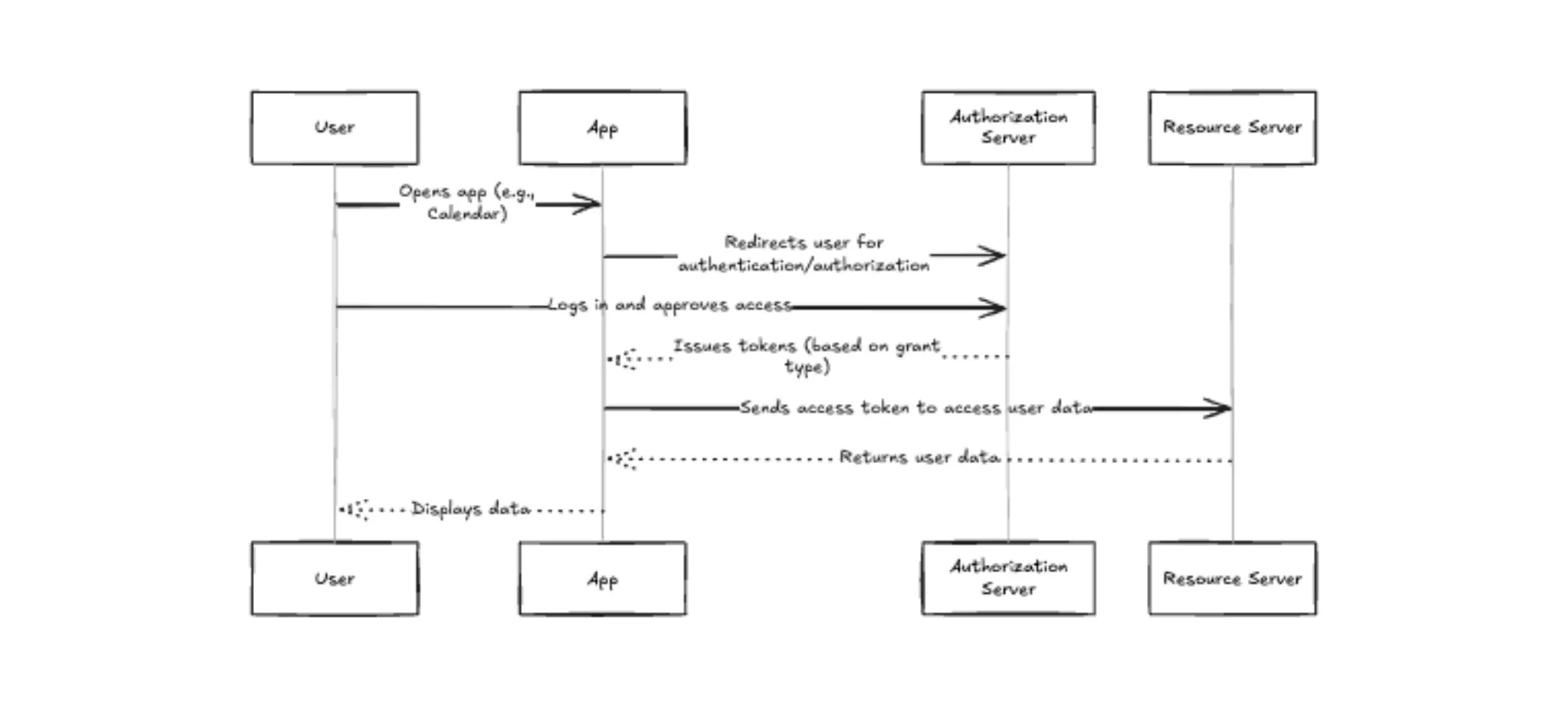
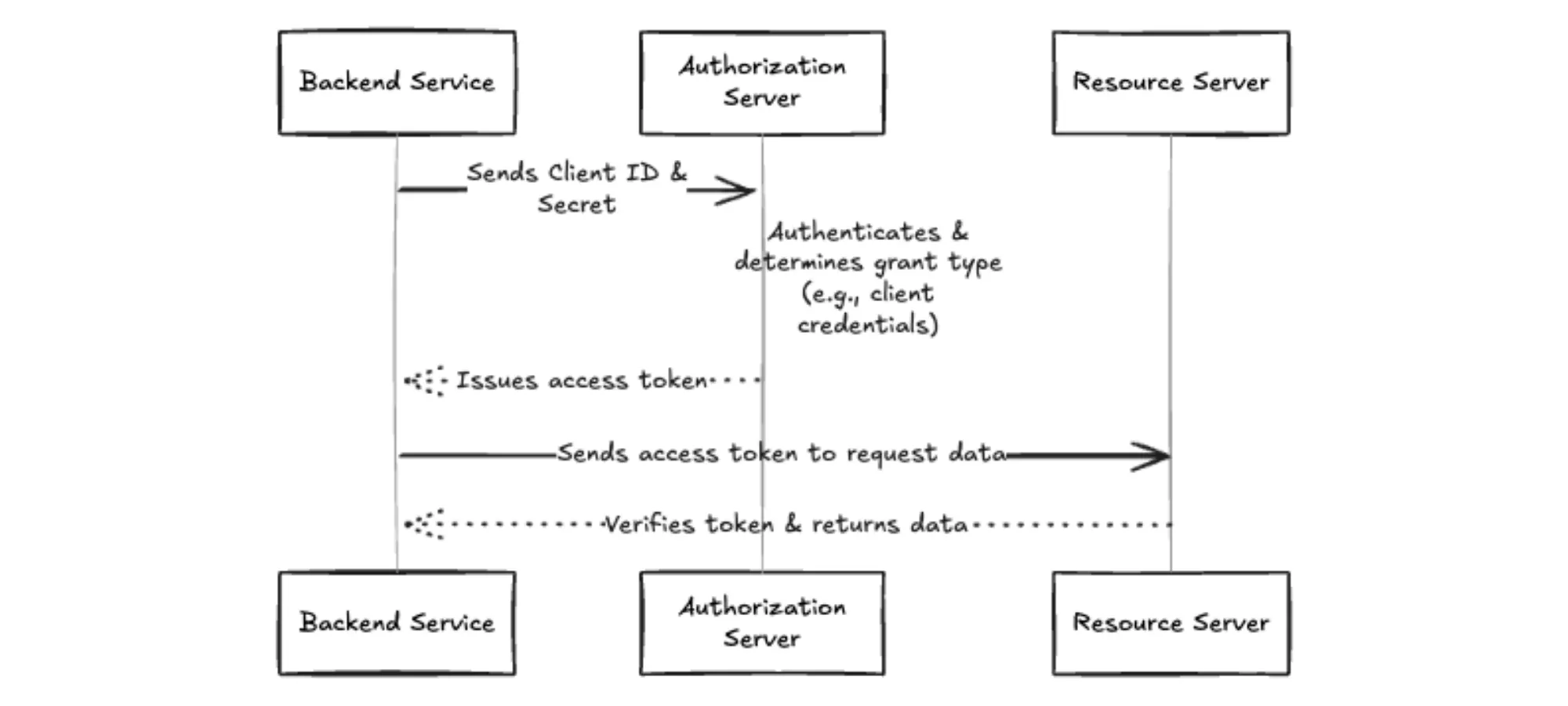
The resource server does not determine how the token was constructed. It validates the token's signature and issuer, confirms that Okta issued it, and then uses the token contents to make authorization decisions. That trust boundary is the foundation for the abuse scenarios discussed later in this blog.
What is OIDC?
OAuth provides authorization. OpenID Connect (OIDC) extends OAuth by adding an identity layer.
When a client requests the OpenID scope, Okta can return an ID token in addition to an access token. The ID token tells the client who the authenticated user is, and the access token tells the resource server what actions should be permitted.
Although they serve different purposes, both tokens are trusted for the same reason: they were issued and signed by Okta.
In this architecture, Okta acts as both the IdP and the authorization server. It authenticates the requestor, constructs the tokens, and signs them before they are consumed by downstream systems.
How Tokens Become Trusted Authorization Decisions
The next question is how Okta determines what appears inside a token.
Tokens contain claims and scopes. Claims describe the subject and context of the request, such as a user identity, group membership, role, application identifier, or other attributes. Scopes define what access has been granted.
Resource servers frequently rely on these values when making authorization decisions. They do not determine how those values were derived. They assume the authorization server correctly enforced the policy before issuing the token.
For example, an API may grant administrative access based on a role claim, or allow access to a privileged endpoint because a specific scope is present. If those values appear in a valid token, the resource server trusts them.

In typical Okta deployments, ID and access tokens are JSON Web Tokens (JWT).
A JWT contains:
A header describing the token type and signing algorithm
A payload containing scopes and claims
A signature proving the token was issued by Okta
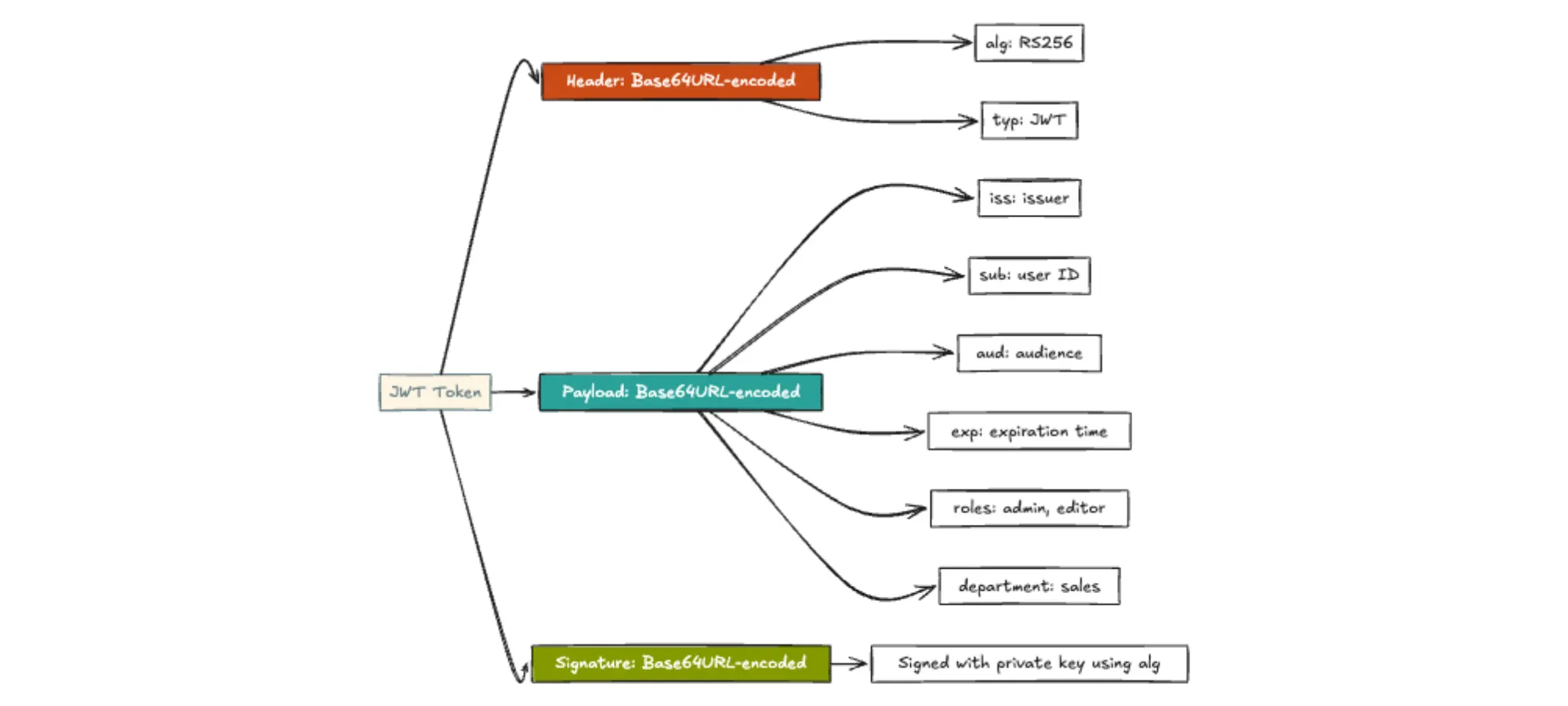
The payload contains the identity and authorization information that downstream systems rely on. The signature is what establishes trust. Once a token's signature is validated, the receiving application treats the contents of that payload as authoritative.
Where Okta Constructs Tokens
The trust boundary becomes particularly important when examining how Okta constructs tokens.
Okta provides two types of authorization servers:
The org authorization server - protects the Okta tenant and management APIs
The custom authorization server - protects external applications and APIs
For this research, the custom authorization server is the relevant control point.
Administrators can use a custom authorization server to:
Define access policies
Create custom scopes
Create custom claims
Control which clients may request specific scopes
Attach inline token hooks that modify tokens before signing
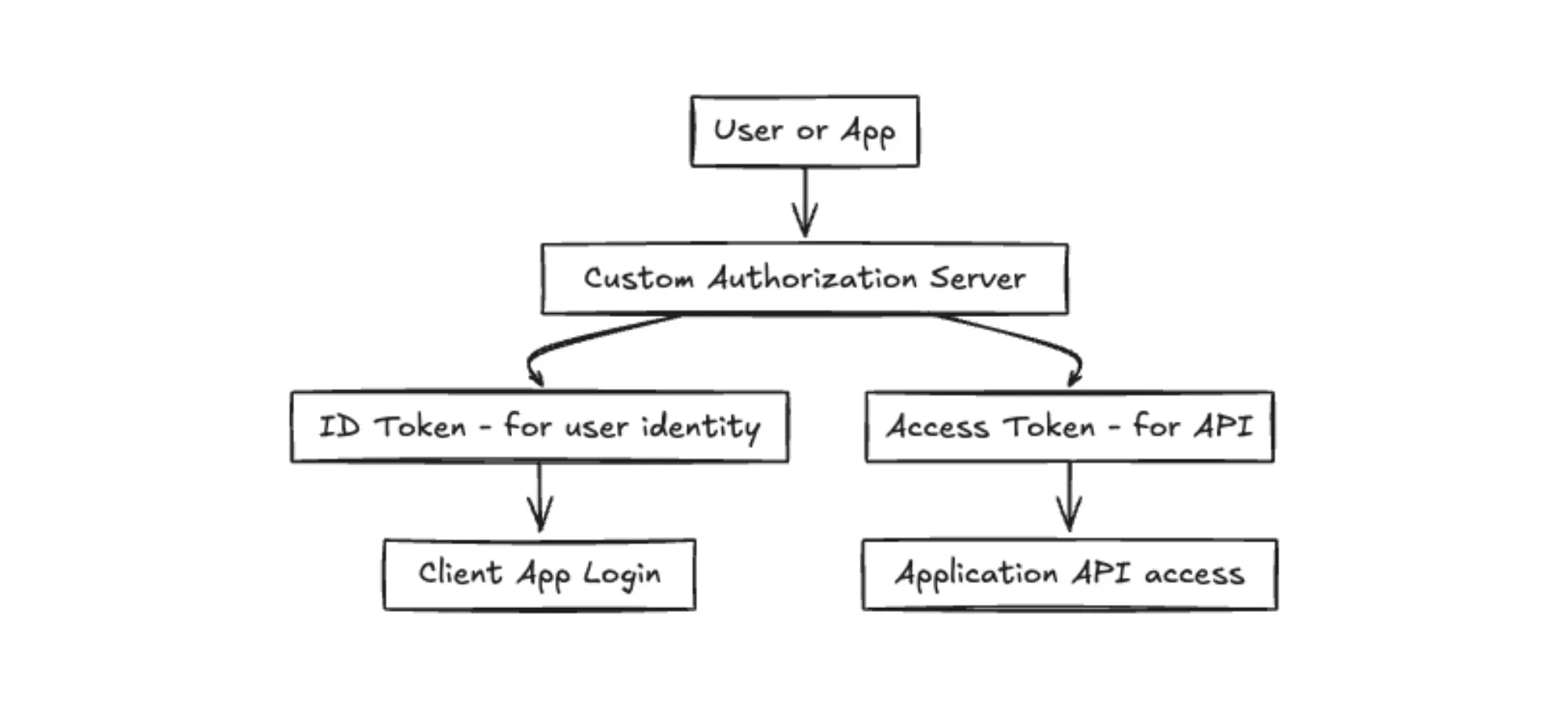
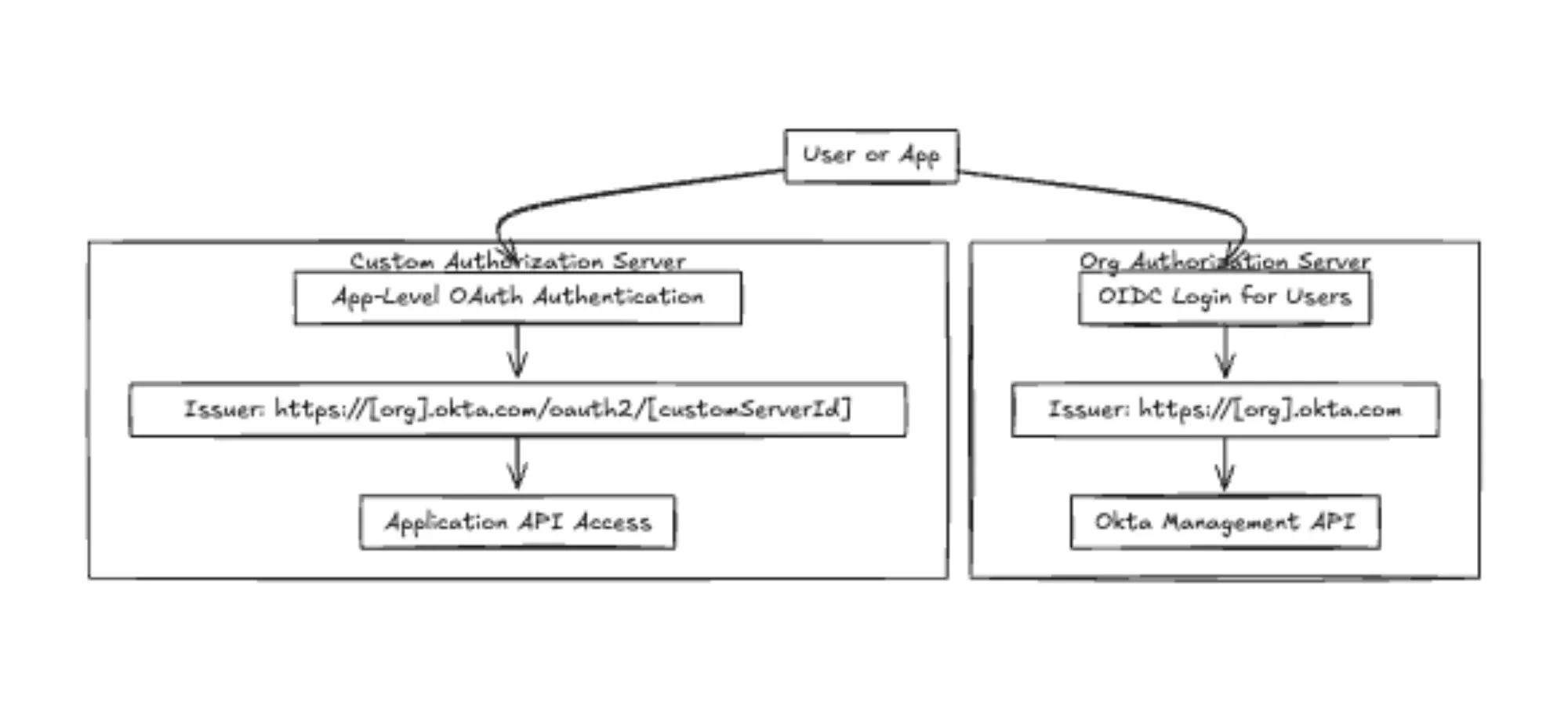
The authorization logic relevant to these attacks is centralized here. The custom authorization server decides what claims and scopes will be included before the token is cryptographically signed and delivered to downstream systems.
This research assumes an attacker has already obtained administrative control over these authorization-server workflows. Under that condition, the attacker does not need to bypass JWT signature validation or compromise the resource server. Instead, they can influence how trusted tokens are constructed inside Okta before those tokens are issued.
The following attack vectors demonstrate two ways this trust boundary can be abused:
Modifying claims and scopes directly within a custom authorization server
Using a Token Inline Hook to alter token contents before Okta signs the token
Abuse Examples Involving Trusted OAuth and OIDC Tokens
Example 1: Manipulating Hasura Authorization with a Token Inline Hook
Hasura GraphQL enforces row-level access control by validating an Okta-issued access token and evaluating claims within the hasura_claims namespace.
The objective: obtain administrative access to data using a client that Hasura should not treat as an administrator
Setup
Hasura is configured to trust the Hasura custom authorization server and loaded with sample data.


Finally, row-level permissions are configured to evaluate the X-Hasura-User-Id claim within the hasura_claims namespace.
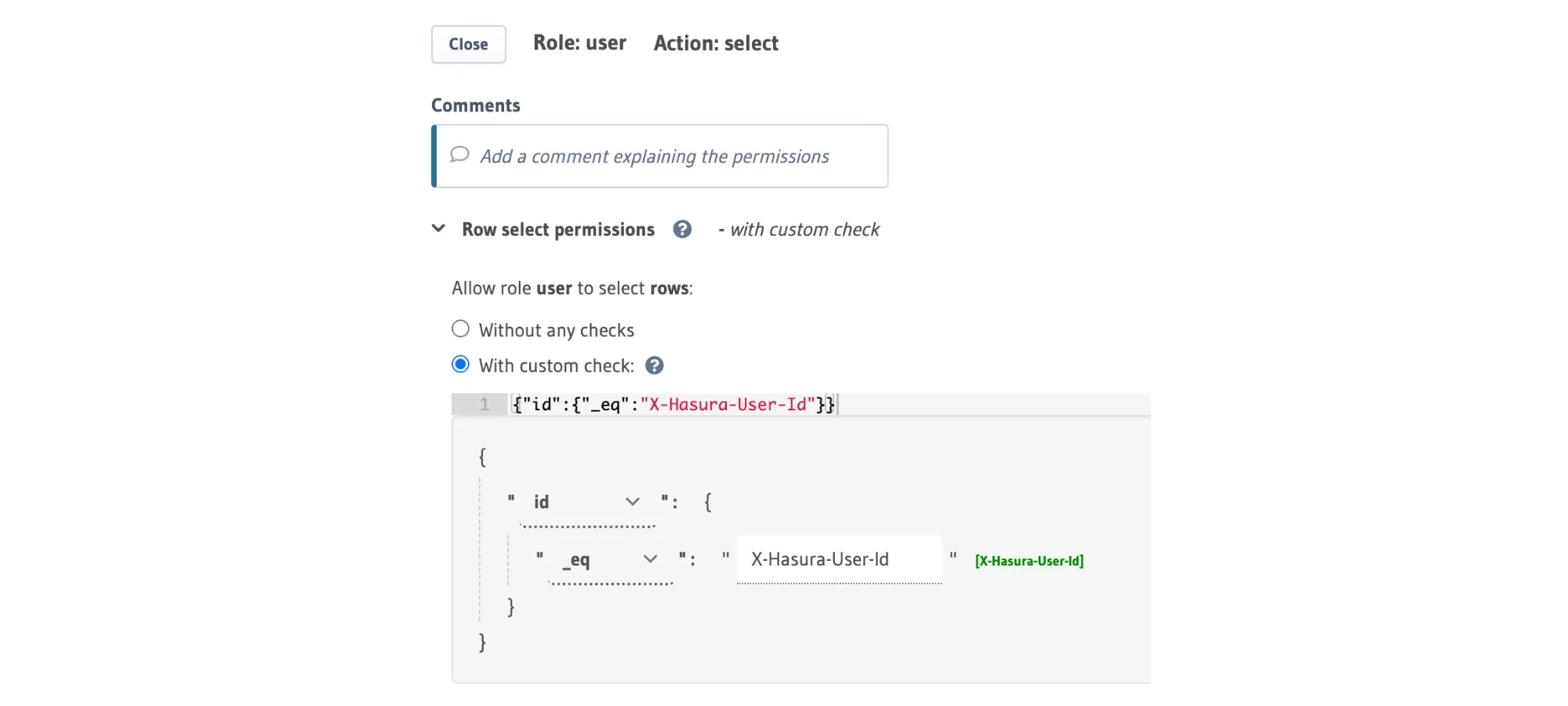
At this point, Hasura’s authorization model is functioning as intended, making access decisions based solely on claims contained within a valid Okta-issued access token. To validate this behavior, we request an access token for a standard user and present it to Hasura, which correctly returns only user-authorized data and provides no visibility into administrator-level information.

Token Manipulation
Rather than attacking Hasura directly, the attack targets Okta’s token inline hook. A hook is created that injects administrative Hasura claims into an access token before Okta signs it.
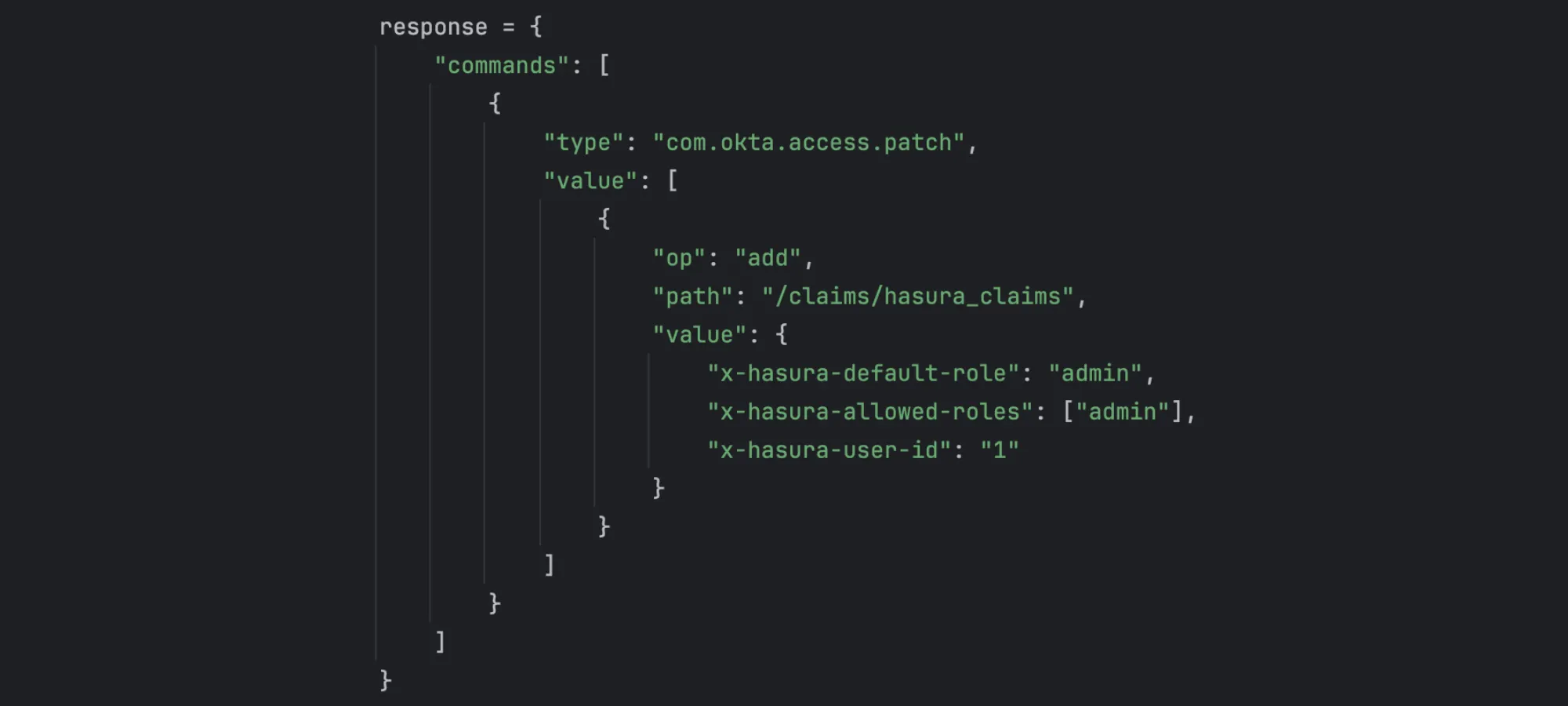
The custom authorization server is then configured to invoke the token inline hook.
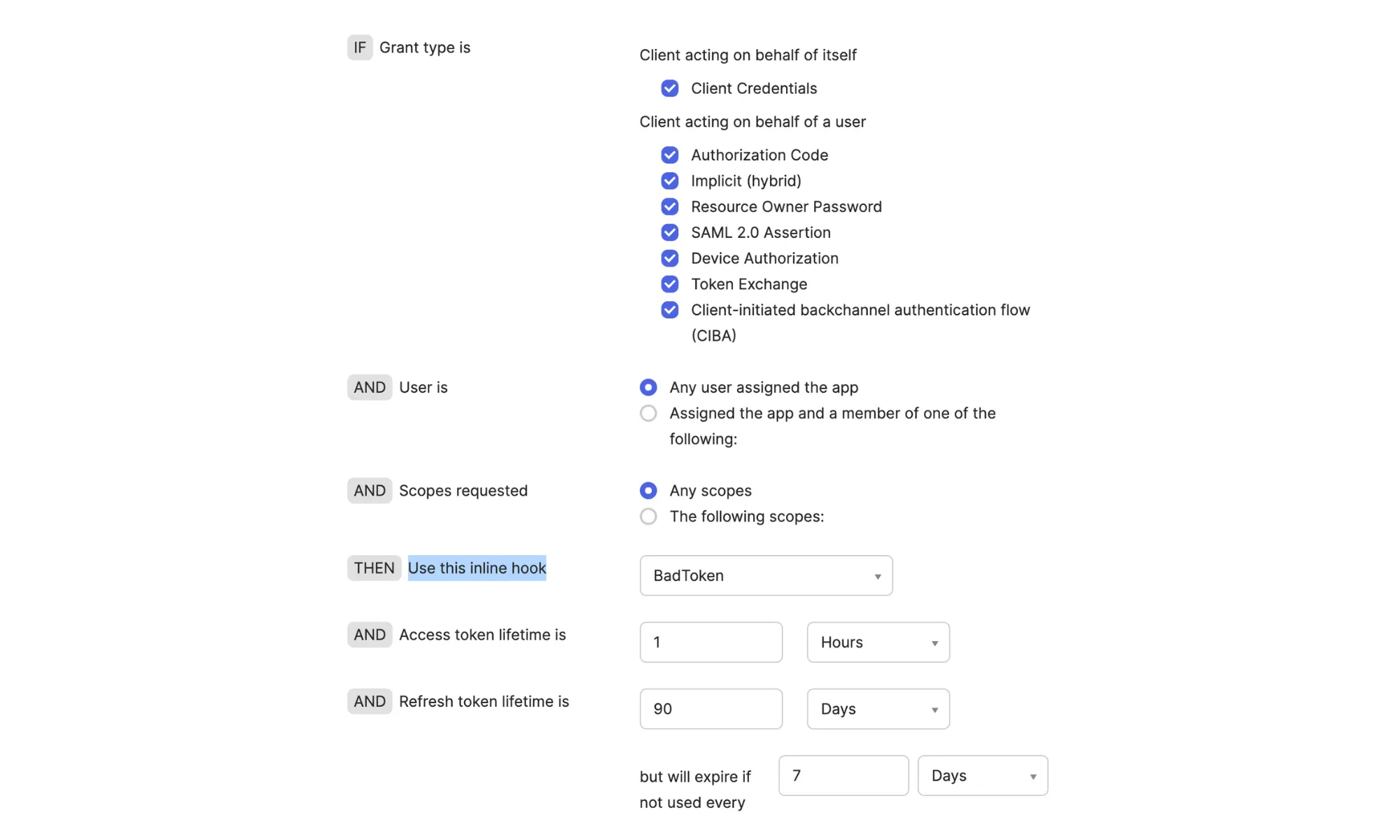
Note that none of these changes touch Hasura. Its permission model and authorization logic remain unchanged.
Result
An access token is requested from the custom authorization server. Note this is a client_credentials token: it represents a machine and contains no authenticated user.

Inspecting the resulting token shows the injected Hasura administrative claims.
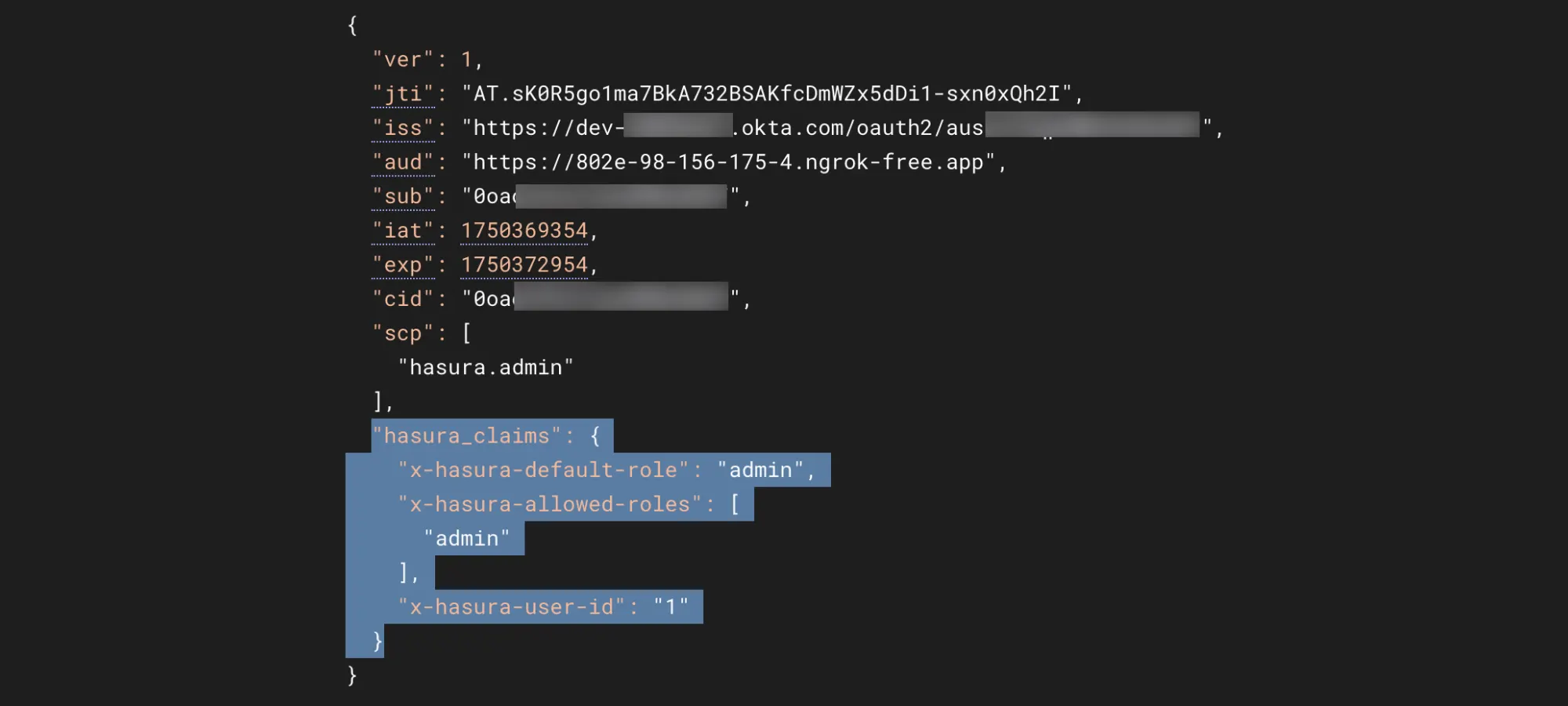
The token is presented to Hasura and it returns all records, including data that should only be available to an administrator.

Hasura did nothing wrong; it validated a genuine, signed token and enforced its rules against the contents. A compromised IdP is not just an authentication problem but also a downstream authorization one.
This example used a token inline hook to modify claims before signing. However, the same trust boundary can be influenced directly within the authorization server itself.
Example 2: Claim Manipulation in a Custom OIDC Application
The Hasura example showed how a token inline hook can modify an access token before signing. This example shows the other angle: modifying an ID token directly inside the custom authorization server.
To demonstrate this, a simple OIDC application is configured to authenticate through Okta and display the ID token it receives after login.
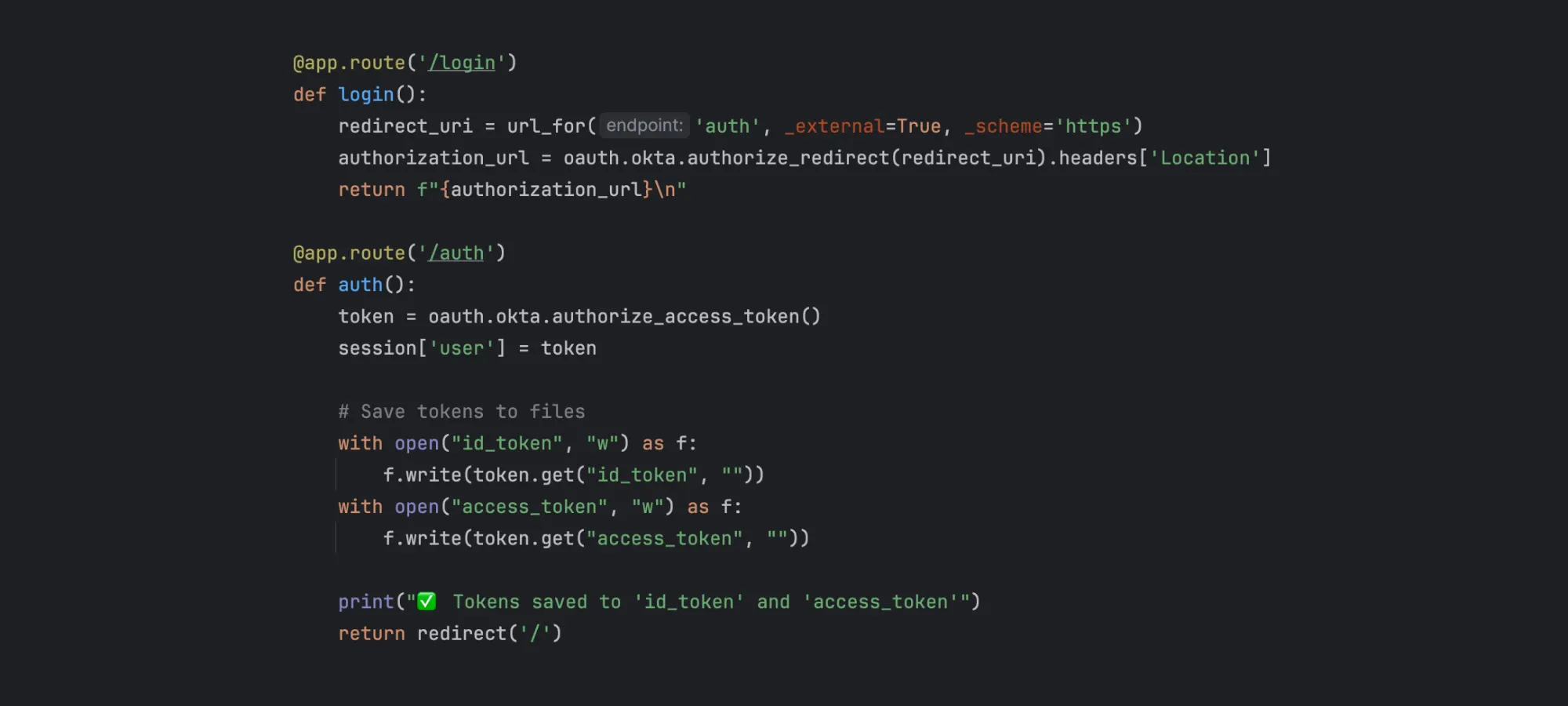
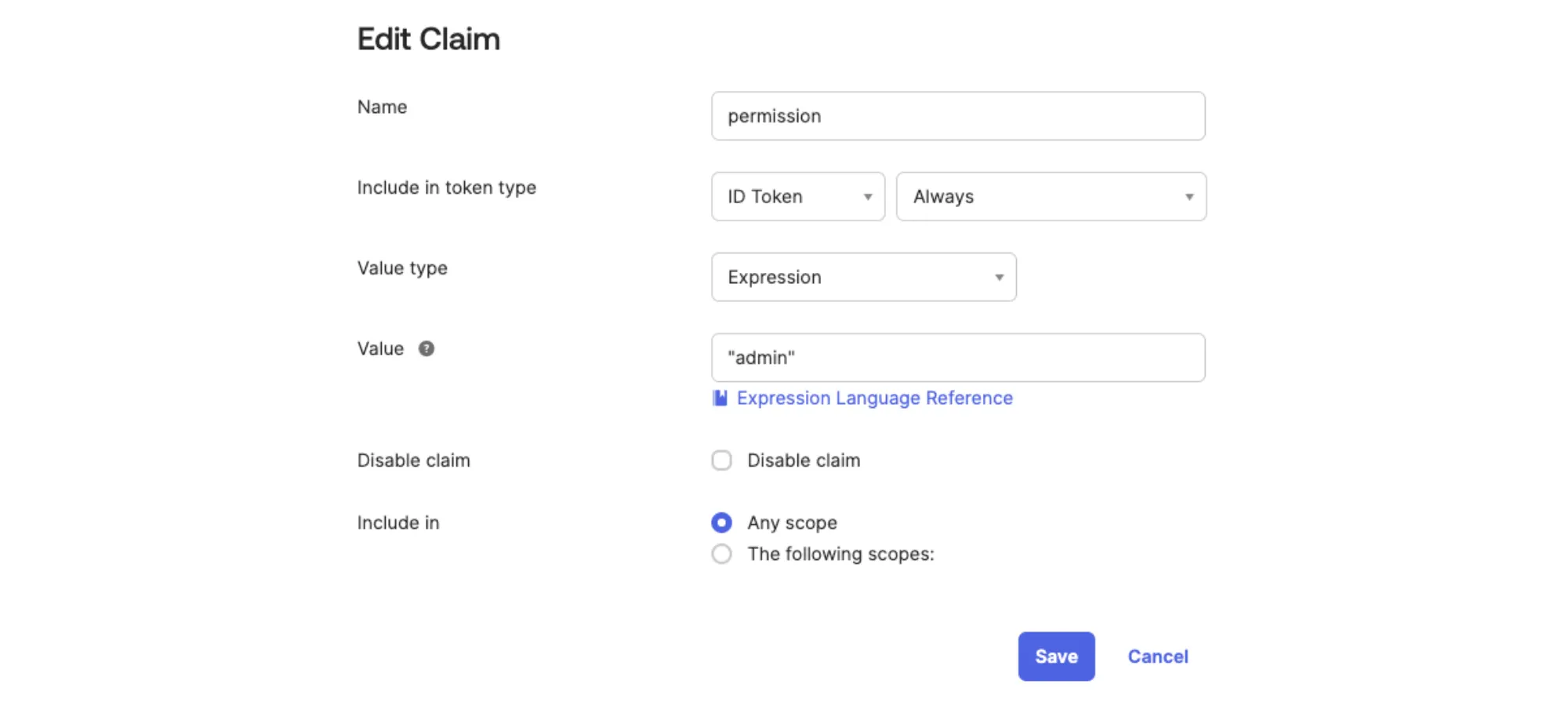
A custom claim is added to the authorization server so that Okta inserts a permission value into the token during construction.
After authentication, the application receives a validly signed ID token containing the injected permission claim.
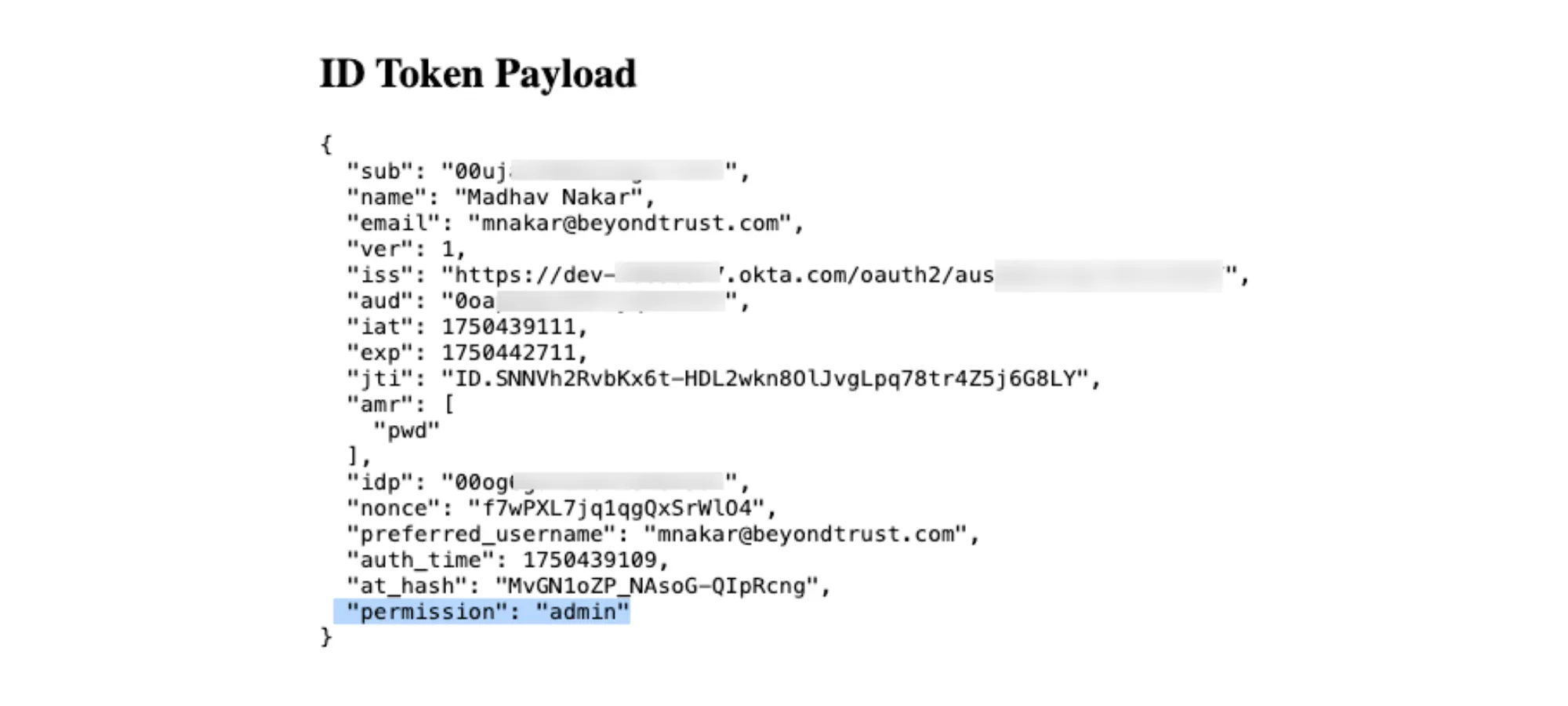
Many applications rely on application-specific claims embedded in ID tokens to drive identity and authorization decisions. If an attacker understands which claims are trusted and can influence token construction within Okta, they can insert those claims into a token that appears completely legitimate to the application.
Attack Limitations
Okta does enforce meaningful constraints on token modification.
Registered claims such as sub, iss, and aud cannot be modified in an ID token, neither through a token inline hook nor directly within the custom authorization server. Okta enforces this restriction to maintain compliance with the OpenID Connect specification and preserve the integrity of identity tokens.

In contrast, access tokens are different. Because OAuth allows the authorization server to define the structure and contents of an access token, the same registered claims can be modified before the token is signed.
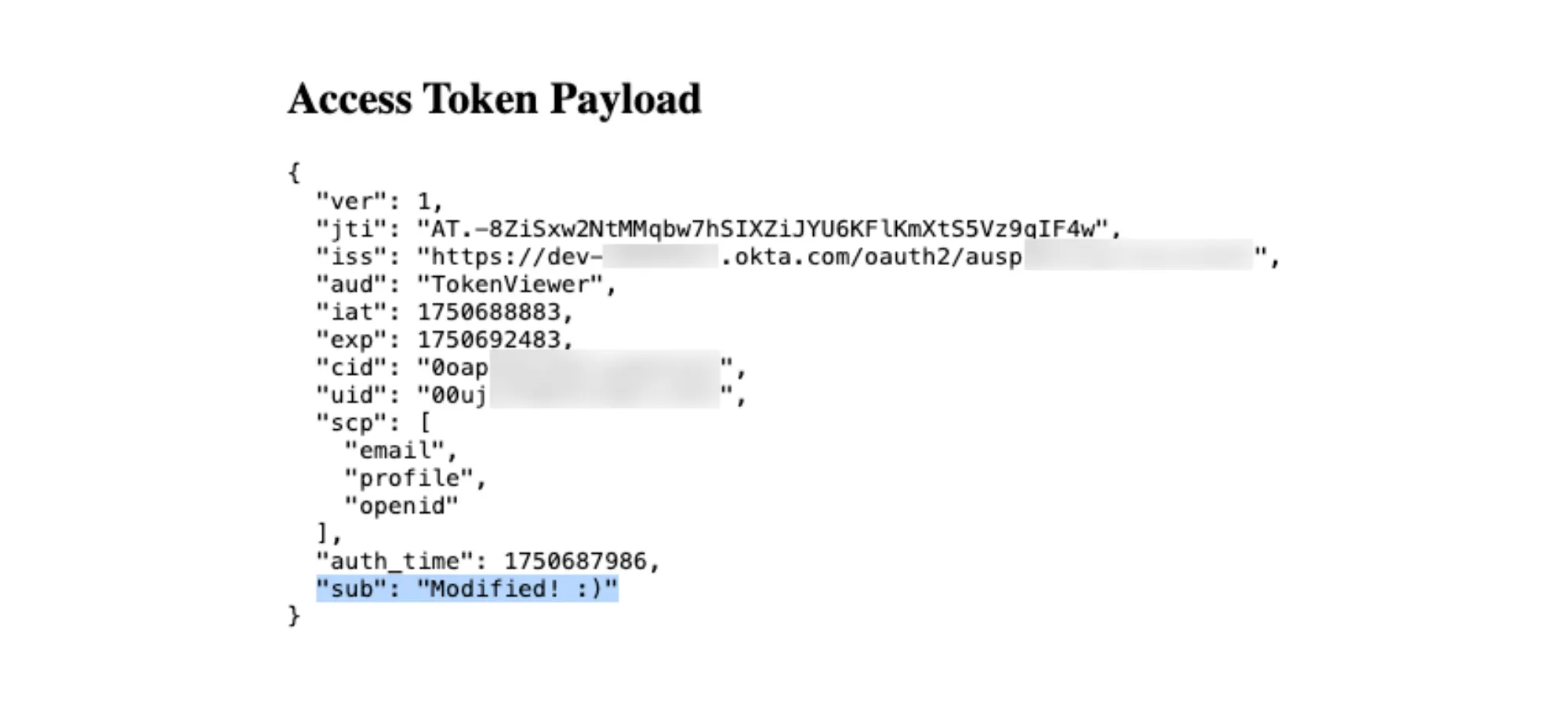
This distinction defines where the attack can be applied most effectively. While registered ID token claims are protected, many applications and APIs make authorization decisions based on access-token claims. If those claims are modified inside Okta before signing, downstream systems will continue to trust the resulting token because the signature remains valid.
Detection opportunities for defenders
Detection 1: Identify Applications that Trust Custom Identity or Authorization Claims
Review client applications and APIs for the following patterns:
Identity decisions based on custom claims in ID tokens
Authorization decisions based on claims or scopes in access tokens
Relying on non-standard claims, custom roles, group memberships or permission attributes
Applications that make security decisions based solely on token contents inherit the trust assumptions of the IdP. In the Hasura example, a client_credentials access token containing injected identity claims was sufficient to influence authorization decisions.
Understanding which claims are trusted and where they are consumed can help identify applications that may be susceptible to token manipulation attacks.
Okta sources:
Detection 2: Monitor Changes to Token Issuance Workflows
Monitor administrative changes affecting:
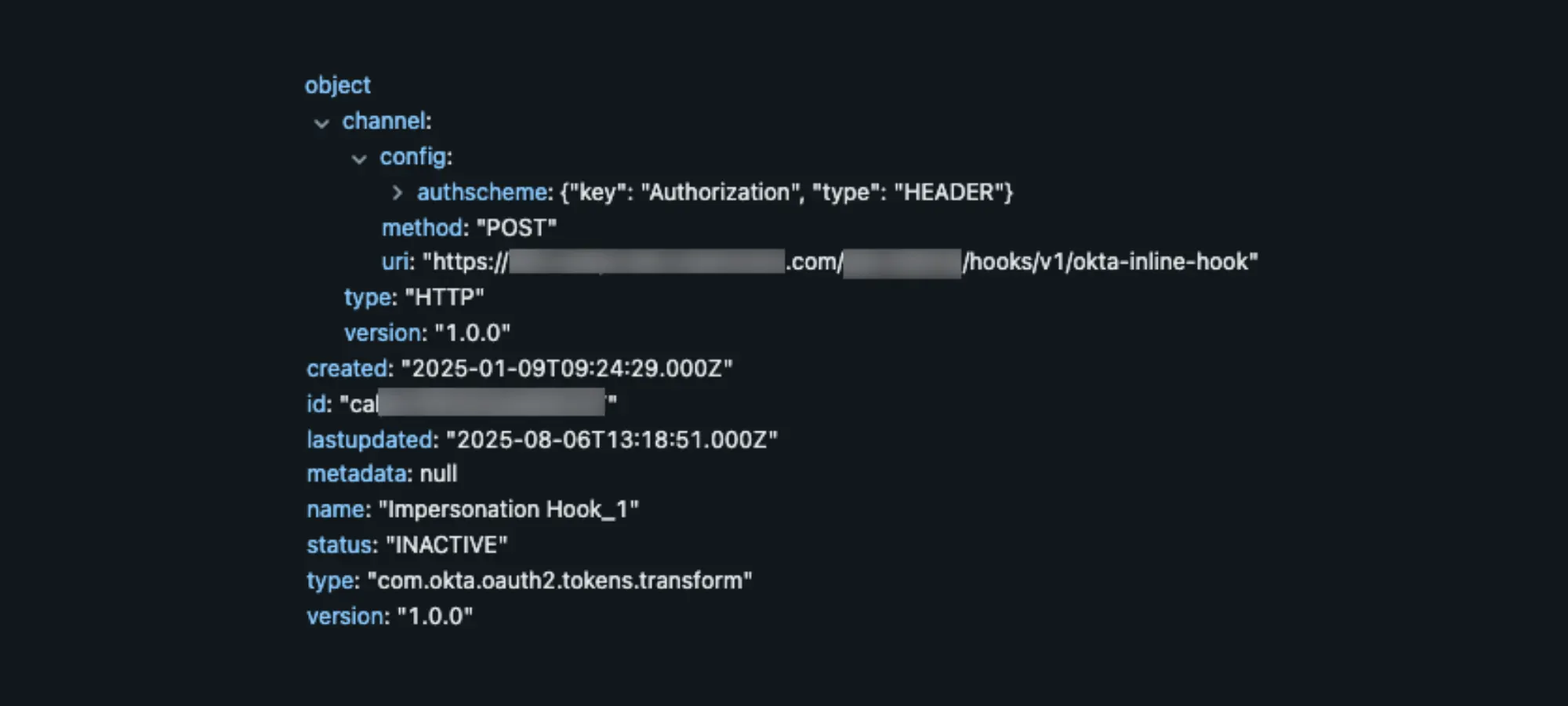
New token inline hooks
New custom claims and scopes
Changes to the authorization server and access policies
These settings directly influence the contents of tokens before they are signed and delivered to downstream applications. Because these modifications occur within the identity trust boundary, unexpected changes should be reviewed and correlated with approved administrative activity.
As a broader trust-boundary monitoring strategy, defenders should also monitor events such as app.oauth2.trusted_server.add and app.oauth2.trusted_server.delete, which indicate changes to authorization-server trust relationships. For threat hunting, app.oauth2.as.token.grant.access_token and app.oauth2.as.token.grant.id_token can provide visibility into token issuance activity, although their volume generally makes them more useful for hunting than alerting.
Conclusion
Identity Providers sit at the center of modern enterprise trust relationships, making them one of the most high-value targets for attackers. Whether through SAML assertions, OAuth access tokens, or OIDC ID tokens, the common theme is the same: downstream systems trust what the IdP signs. As organizations continue to centralize authentication and authorization within their identity platforms, understanding where trust is created, modified, and enforced will be critical to securing the modern enterprise.
For further reading on Okta exploits, check out the first blog in the Hooked on Identity series, Hooked on Identity: Abusing SAML Assertion Inline Hooks in Okta
Explore More Research from Phantom Labs
Phantom Labs™ researchers "think like attackers" to expose privilege escalation paths and identity attack vectors, helping defenders proactively uncover misconfigurations and detect threats in complex hybrid and cloud environments. Using advanced graph modeling, Phantom Labs researchers map attack paths to privileged access across cloud and on-premises infrastructure.
Continue Reading
https://www.beyondtrust.com/blog/entry/abusing-okta-saml-assertion-inline-hooks
https://www.beyondtrust.com/webinars/ai-security-ai-agents-in-servicenow
https://www.beyondtrust.com/blog/entry/pwning-aws-agentcore-code-interpreter
https://www.beyondtrust.com/blog/entry/openai-codex-command-injection-vulnerability-github-token